
Newsletter Subscribe
Sign up now to stay up to date with the latest news and developments.

Thank you
Please check your inbox to confirm your subscription.
For clinicians, rarity can influence diagnosis, access to evidence, treatment planning, referral pathways, clinical trial availability, and opportunities for multidisciplinary review.
Understanding these challenges helps explain why rare cancers often require a different approach to decision-making and care.
In Australia, a rare cancer is generally defined as a cancer with an incidence of fewer than six cases per 100,000 population each year.
A less common cancer has an incidence between six and twelve cases per 100,000 population, while common cancers occur at rates above twelve cases per 100,000 population.
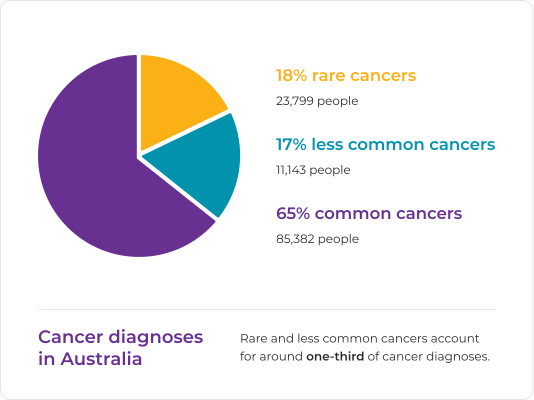
The challenge of rare cancers is often not the disease alone, but the availability of evidence, experience, and expertise.
Clinicians may encounter:
Rare cancers can present atypically, mimic more common conditions, or involve pathology that benefits from specialist review.

Many rare cancers have fewer prospective studies, clinical guidelines, and established treatment pathways than common cancers.

Disease-specific experience is often concentrated across a small number of clinicians, centres, or research groups.

Genomics, emerging therapies, clinical trials, and compassionate-access pathways may play a larger role in treatment planning.

The rarity of these cancers can create practical barriers for both patients and clinicians. Rare cancers commonly take longer to diagnose and may be more likely to be misdiagnosed, particularly when symptoms are atypical or overlap with more common conditions.
Treatment planning can also be more difficult. Clinical guidelines may be based on limited evidence or, for some rare cancers, may not exist. Finding clinicians or specialist centres with direct experience in a particular rare cancer can be challenging, especially for patients outside major metropolitan centres.
These challenges can affect access to:
While every case is different, rare cancers can create barriers that are not routinely encountered in more common cancers. This is why access to specialist expertise, collaborative review, and broader treatment pathways can be so important.
No clinician can be expected to maintain deep expertise across hundreds of rare cancer diagnoses.
Collaborative review and access to specialist networks can help:
For many rare cancers, access to expertise is as important as access to treatment.

ARC Portal was established to help clinicians access specialist rare cancer expertise when additional insight may help guide diagnosis, treatment planning, or access to care.
The ARC Portal is particularly valuable for clinicians with rare cancer patients in rural, regional and remote areas, without easy access to specialised advice and support.
By connecting clinicians to a broader network of experts, ARC Portal helps address some of the challenges created by rarity itself.
The following organisations provide trusted information about rare cancers, treatment, support, and research.
Information, advocacy, patient support, and resources for Australians affected by rare and less common cancers.

National information about rare cancer definitions, policy, and cancer initiatives.

National cancer incidence, mortality, survival, and prevalence statistics.

Patient-friendly information about rare cancers and their impact.

Evidence-based clinical information and treatment resources for healthcare professionals.

Patient-friendly information and support to help people with cancer navigate their care with confidence.
Free online education to help primary care professionals recognise, refer and support people affected by rare and less common cancers.